



|

HAMILTON
GENEALOGY
LINE
The
HAMILTON
Family
Tree
Rachel
Hamilton
(1774 - 1858)
Archibald
Hamilton
(1743 - 1820)
Ninian
Hamilton
(1717 - 1784)
Andrew
Hamilton
(1655 - 1719)
William
Gavin
Hamilton
(1630 - 1698)
John
Hamilton
(1603 - 1???)
James
Hamilton
(1575 - 1618)
_________
_________
LINKS
History of
NC Counties
CARS
Catawba
Station
Township
Catawba
Elementary
& High School
Cemeteries
The
CIVIL
WAR
Additional
Family
SURNAMES
Genealogy
HUMOR
PHOTO
LINKS
Slavery
Twins
WHERE
TO
FIND 'EM
PAGE
________
FAMILY
NAMES
LOFTIN:
Beatty
Corzine
Cranford
Fisher
Givens
Harwell
Kaiser
Lanier
Lomax
McCorkle
Rudisill
Sherrill
Upright
Washington
Work
SETZER:
Aderholdt
Barringer
Bovey
Bushart
Deal
Heavner
Herman
Ikert
Miller
Motz
Rankin
Witherspoon
GOBLE:
Babst/Bobst
Douglas
Faber
Fink
Fulbright
Hefner
Meinhert
Miller
Muller
Pabst/Bobst
Robinson
JOHNSON:
Corzine
Fink
Hamilton
Kaiser
Leslie
Lewis
Moore
Sherrill
Upright
Wilkinson
|
|
|
|
Archibald Hamilton
II |
|
|
|
|
|
Born: 19 Dec 1785, Lincoln County, NC Died:
April 4, 1860, Washington Cnty, IN |
|
|
|
|
|
|
|
|
|
|
|
|
|
|
|
|
|
|
|
|
|
|
|
|
|
|
|
|
|
|
|
|
|
|
|
|
|
|
|
|
|
|
|
Archibald Hamilton II was born 19 Dec 1785 in Lincoln County, NC. He was the son of
Archibald Hamilton (b. 1743) and Mary "Polly" Hawkins (b. 1756). |
|
|
|
|
|
Archibald II had at least ten siblings: |
| Name |
Birth Date |
Death Date |
Spouse |
|
Rachel Hamilton |
Abt. 1774 |
|
David Sherrill |
| Mary Hamilton |
|
|
|
| Elizabeth Hamilton |
|
|
|
| Margaret Hamilton |
Aft. 1775 |
|
Jacob Lollar |
|
Rueben Hamilton |
1776 |
|
Sarah Collier |
|
Thomas Cleophas Hamilton |
01 Feb 1784 |
|
Mary Ann Taylor |
|
Ninian Bealle Hamilton |
19 Feb 1789 |
|
(1) Mary Margaret Wilfong
(2) Priscilla Newton |
| Ruanna Hamilton |
06 Feb 1793 |
|
Ephraim Kale |
| (Unknown) Hamilton |
|
|
|
| (Unknown) Hamilton |
|
|
|
|
|
|
|
|
|
Archibald II married Susannah Bridges. Susannah was born
07 Dec 1787. |
|
|
|
|
|
Archibald II and Susanna had 5 children: |
| Name |
Birth Date |
Death Date |
Spouse |
| Mary "Polly" Mahala Hamilton |
21 Jun 1810 |
28 Feb 1905 |
Valentine Baker |
| Thomas Hamilton |
03 Jun 1813 |
30 Dec 1869 |
Elizabeth Hise |
| Archibald Hamilton III |
27 Apr 1818 |
11 Jul 1882 |
Rebecca Wells |
| James Bridges Hamilton |
16 Oct 1820 |
26 Oct 1899 |
(1) Elizabeth Rice
(2) Euphrasia Stuckey |
| Elisha "Lish" B. Hamilton |
11 Sep 1822 |
13 Nov 1894 |
Drucilla Rice |
|
|
|
|
|
|
|
|
|
|
|
|
|
|
The 1810 Census shows Archibald (b. 19 Dec 1785) was living
nearby his brother, Reuben Hamilton. Archibald and
Susannah had only one child at the time, Mary "Polly" Mahala
Hamilton. |
|
|
|
1810 Census |
|
 |
|
|
| Name |
Males |
Females |
| Under 10 |
10 - 15 |
16 - 25 |
26 - 44 |
45 & Up |
Under 10 |
10 - 15 |
16 - 25 |
26 - 44 |
| Reuben Hamilton |
4 |
|
|
1 |
1 |
2 |
|
|
1 |
| Arch Hamilton |
|
|
1 |
|
|
1 |
|
1 |
|
|
|
|
|
|
|
|
|
|
|
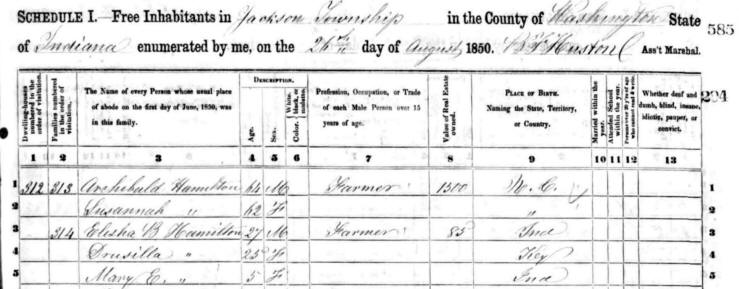
The 1850 Washington County, Indiana, Census shows that Archibald
(age 64) and Susannah (age 62) were living in Jackson Township.
The value of Archibald's Real Estate was $1500. Their
youngest son Elisha was living at the nearest farm with his
wife, Drusilla, and their daughter, Mary Ellen. |
|
|
|
|
|
1850 Census, Jackson Township, Washington County, INDIANA |
|
 |
|
|
|
|
| Name |
Age |
Sex |
Occupation |
Real Estate
Value |
Birth |
| First |
Last |
| Archibald |
Hamilton |
64 |
M |
Farmer |
$1500 |
NC |
| Susannah |
" |
62 |
F |
|
|
" |
| |
|
|
|
|
|
|
| Elisha B. |
Hamilton |
27 |
M |
Farmer |
$85 |
Ind. |
| Drusilla |
" |
27 |
F |
|
|
?? |
| Mary E. |
" |
5 |
F |
|
|
Ind. |
|
|
|
|
|
|
|
|
|
|
|
|
|
|
|
|
|
|
|
|
|
|
Archibald
Hamilton II's move to Indiana: October 15, 1817 |
|
|
THE STORY OF
MARY (POLLY) MAHALA HAMILTON
AS TOLD BY HER DAUGHTER, SUSAN (born 1835) |
|
|
|
(Mrs. Simeon
Boss) |
|
|
|
(written 1905, see Skelley History RHR) |
|
|
|
|
|
|
|
I write this in memory of my mother, Polly Mahala
Hamilton, who was born June 21, 1810 in North Carolina, Lincoln
County. Her parents were Archibald Hamilton (II) and Susannah
Bridges Hamilton. The
grandfather and grandmother Bridges were born in Prince William
County, Maryland. (This must be what is Prince
William County, Virginia, now). He was
married with a claw-hammer coat and knee-breeches, as they
called them at that time. And, a ruffle shirt with fancy cuff
buttons, which I still have in my possession. And I still have
the bride's red cloth cloak that my mother fell heir to.
(North Carolina) Mother
lived with her father and mother, in a large log house, and her
brother Tommie, also. It was hewn out of pine trees. And a
fine spring was nearby. She and little brother would go after
water and play for hours in the white sand, barefoot.
Grandfather would go to his
brother Reubens, bring back a wallet (bag)
of apples and they were in their glory
just waiting until
Grandmother could bake them half-moons in the spider on the
hearth, before a roaring fire of pine knots.
They had a black cow that mired down in a swamp, had to
get the neighbors to help rescue her. They would go with their
father fishing in a canoe on the Catawba River, and always get
plenty of fish, and they would sail along the banks and gather
muscadines, a small grape, but larger than our wild grapes.
Sometimes would have their canoe full of grapes and fish. They
had some deer there, but not plentiful.
She went to church in private houses, and as that was a
slave state, the colored folks stayed on the porch and in the
yard, the white ones enjoyed the inside of the room. I am glad
to say none of the Hamiltons
were slave holders. (Apparently they were later - see
letter dated RHR) It was
something they did abhor, keeping human
beings in bondage. One time she and her parents went to church
at a private house, and when services were over several went
out. A young girl went down the path from the house where there
were a row of cucumbers - there she picked up a large one - held
it behind her, and went on, when all in the house could see her.
That amused Mother, small as she was. So many little incidences
like that she would tell and never tire.
Grandmother Bridges would come with her knitting -
walking - and Mother would lay sweet potatoes in the ashes to
roast for her to eat before she started home in the afternoon.
She was a very slender low woman and wore linsey and flannel in
winter, cotton and flax (linen) in
summer.
Mother went to school one summer there in a small log
cabin with a dirt floor, in an outcast broomsage field. The
older girls would break the broomsage off, tie it up and sweep
the floor perfectly clean. The teacher would sing every morning,
"How Tedious And Tastless The Hours", the old-time song every
one that could sing must do so, and by memory. She had what she
called a "First Primer" (reader)
and kept it for many years.
She was very active with her needle - wanted to sew
with straws, so Grandfather went with her to a country store,
set her up on the counter, and had her try on thimbles - was
trouble to get one small enough. He finally found one that would
fit and bought two needles, also. That was a proud day for her
as she went home to tell Grandmother, and she gave her a ball of
cotton thread to sew with. She said she would sew for hours out
in the shade of the trees.
Grandfather had a lease on his brother Reuben's farm
for ten years - always said when the lease run out he would
emigrate to a new country - and when it expired in 1816, great
preparations were made for the move to Indiana, as they had
decided on that new country.
The first thing to prepare was a stout, very strong
wagon to go over the mountains. Uncle Ninian, his brother, was a
first-class blacksmith (according to letter dated October
24, 1820 Ninian was just learning the smith trade. RHR)
and was working at it when one night the
shop caught fire and everything burned. So, they had to wait
another year to have good seasoned wood to use for the wagon.
They waited patiently and kept working on. Grandmother made more
linsey flannel and jades as they made all their clothes then.
She made many buttons with thread - Mother could make them also.
She saved all kinds of garden seed to bring to the new country,
also all kinds of dried herbs, and a pint of apple seed.
Well, the wagon was finished with hoops and very heavy
muslin drawn over the top, with a gathering string in the back
to draw it together - it sure was perfect in every detail. In
the fall of October, 1817, early one morning all the neighbors
came in to eat breakfast with them and bid them good-bye, and
had a season of prayer before they departed for the new country.
Had forgotten to mention the church denominations there - were
all Methodist, Episcopal, and Baptist. The neighbors all helped
load - part of them went with them until dinner time, when they
ate a hasty dinner. That first day, among the number that went,
was Grandmother Bridges, and when she started to turn back,
Mother said there were tears in her eyes. No wonder, as three of
her daughters, Grandmother, Betsy Hayden and Bridges, Nancy
Litton came also, in the one wagon.
Grandfather had four horses to start with - one got
foundered eating green corn on the road - could not pull much.
Mother and brother Tommie would ride on him sometimes.
They were over six weeks coming. Came over Paint Mountain Clinch
and Cumberland Mountains. Some have changed their names since
they came through the Cumberland Gap. That was such a noted
place during the Civil War. Mother said they all walked quite a
good many miles - said she never wanted to go over that road
again. When they camped for the night the wolves would howl and
the children would cover up their heads. The men would keep up
fires which was said to scare them away. Grandmother would go
out of the wagon and blow a trumpet, about five or six long
blasts, that would quiet them most of the night. Grandpa was a
great hunter - very apt with firearms - and he shot several
kinds of game as they were coming.
They came to a large stream one day where there had
been a log house torn down, but the fire-place and part of the
chimney remained. So, they tarried there two or three days,
washed and baked enough to do them several days, and rested up
considerable. Someone said let the afflicted horse stand in
water and they did and it helped him. They ironed their clothes,
stretched them over the chair backs. A few times when they got
out of grub, would stop at some cabin along the way for
something, and they were always made welcome, and given all they
wanted if they had it, without money or without price,
especially if they were colored folks.
As they got up one mountain several wagons of travelers
were along - one young man clapped his hands on his sides and
crowed to the delight of the children. That much of the travel
was over. In after years, Mother found out that he lived near
Salem. She went to see him and talked over old times. His name
was Stover, and he lived to be very old.
Many were the ups and downs they had. They did not
travel on the Sabbath as they were taught by their parents it
was a sacred day set aside for rest. They camped in some quiet
place on Saturday night, next morning read the Bible, sang
songs, had prayers by all the family. All during the day it was
like an old- fashioned love feast, sure enough, that our young
people know nothing of in these days.
They built fires with two flints knocked together,
which made sparks on coarse tow which caught fire. Had brought
their faggots of pine kindling with them. Never had seen any
matches at that time. They crossed the Ohio River at a
little town, called Utica, Clark County, now - on a flat boat as
they did on all other large rivers. They were now in Indiana,
where so long they hoped to have a home of their own. This was
one year after the state had been admitted to the union. They
traveled several miles, was weary, so Grandmother said, "We are
here now, let us stop and hunt a home." One evening late, they
came to a log cabin, and wondered if they could stop over night
and rest up. They went to the nearest house, inquired who owned
it, and could they stay a few days there? The good man of the
house said, "Why, yes, if you can clean it out - had it full of
fodder last winter - and welcome to it".
Grandfather told him they were moving and wanted to buy
land the first opportunity. They all went to work, cleaned it
out, and Mother said there was a very large blessed fire-place.
They soon had their supper, fed their horses, tethered them out
all night. Soon had their comforts and blankets on the puncheon
floor, and down to sleep under the first roof they had slept
under for over six weeks.
Getting rather
cool by this time. Next morning Grandfather cut fodder on the
shares for his horses. Grandmother pulled turnips on the shares,
and Mother and Tommie piled them and cut off the tops. She kept
on and pulled them all, and the woman gave her two hens for her
work, and the children were surely pleased, called them their
pets, and thought Indiana a fine place. Those people's name was
Sellers, as were those of several of the neighbors - I suppose
that is where Sellersburg got it's name.
Grandmother's sisters, Betsy and Bridges, Nancy, went
farther on, in what is known now as Spencer County, Indiana.
Grandfathers stayed there several days. He helped all the
neighbors work at various things, and sent the news out that he
wanted to buy land. One day a strange man rode up, said he
wanted to see the man what wanted to buy land. Said he wanted to
sell his, as he had moved his family from Kentucky and found out
he could not keep slaves here, as this was not a slave state,
and his women folks would not stay in Indiana on that account.
Grandpa got on his horse, went with the man several miles, ten
or twelve. The first thing he asked, was there good water? - the
man said the best of water. They walked all over it -
Grandfather thought it very good land, but not much cleared up.
There was a log cabin with a very large fire-place, large rock
hearth, puncheon floor, and under that a little cellar, with
Irish potatoes, and he said there was some not dug yet, and he
could have all of them as his family were already gone.
Grandfather said he would take it, but I never did know what
price he paid. There were also, two log stables for his four
horses.
He returned, said to Grandmother he had bought land. He
said to the man he could not pay him anything on the land until
he collected his sale bills from North Carolina the next summer.
The man said that was all right and returned to Kentucky, not a
line drawn to bind the bargain. Just think how people trusted
one another them days. They made ready to move down home, as
they called it.
Horses harnessed to the covered wagon, which had not
been unloaded yet, only things they needed to use - some fodder
and corn thrown in, turnips, and two hens to the children's
delight, were made ready.
Polly and Hamilton, Tommie got down here just a few
days before Christmas and snow was on the ground, but there was
nothing Polly and Tommie could do, even before they were
unpacked, but go see that nice spring between two rocks. Mother
had her little tin cup in her hand, and they both drank heartily
of the good water of the spring that was to be theirs for many
many years. They went back to the house where Grandfather had
built a heaping log fire, and they were soon warm, although
Grandmother had her feet badly frozen, but soaked them in strong
salt water several nights, which entirely cured them.
Grandfather went in a few days to the nearest neighbor,
a Mr. Knotts that lived northwest of what is now Clyde Martin's
spring, to have him help unload the wagon. There was a large
chest, very heavy with pewter dishes. They used more of them in
those days as Queensware was very hard to get. I have the old
chest, and one pewter dish yet in my possession. Will keep them
while I live. Mr. Knotts then invited them to eat Christmas
dinner with them - they went - and the Knotts had butchered and
had a side of ribs hung before the fire-place. It would turn
around and roast - a pan was set underneath to catch the grease.
Mother said it was just fine, when they ate that up another side
of ribs was roasted in the same way. Had potatoes and cabbage,
and wheat biscuits - they had not eaten any for some time - been
eating corn dodgers. Mother said she would nip off a little at a
time so it would last longer - and they also had maple syrup.
Said they talked about that Christmas dinner for years, and even
after they were grown.
Later they made their own maple syrup - was all the
sweetening they had for years. Did not often see sugar as it was
so costly. Grandfather and Grandmother worked out and cleared up
fields, and burned brush all day, then at night would sew, mend
and knit. Soon got sheep and made all the clothes they wore,
both Sunday and every day clothes also.
As spring came on Grandpa was troubled how he could get
corn to feed his four horses so they would be able to plow.
Inquired around, no corn to be had about here, then someone told
him there was some to sell down in the Grant (now Harrison
County). Well, he did not have the money and he must not go in
debt - he was then told of a man by the name of Wyman who would
loan him the money. he said no, I am a stranger here, and he
would not trust me. They said, yes, he has helped many new
comers. He felt forced to go and ask the favor, and Mr. Wyman
said, I certainly favor you with all the money you need, which
was a God-send to Grandfather in a strange land. Then he said,
do you want the money or corn after I raise it in the fall -
just suit yourself. I have plenty - do not need it - just take
your time. I always help them that try to help themselves. Ever
after they were fast friends. Some of his descendants are here
yet.
These grandparents sowed flax seed to make part of
their clothing, and one summer Lorenzo Dow, that noted preacher
that traveled everywhere, was to preach at Salem. They all
wanted to go, but the flax was ripe and ready to pull, and
Grandpa said that must be done first. They all pulled, the day
before and until about ten o'clock at night, and Polly and
Hamilton, Tommie were so tired, but all right next morning. Part
of the neighbors went, in the big farm wagon that had crossed
the mountains, with the family. They had a platform with a table
on it, and a chair on that, he would sit awhile and stand awhile
and hold on to the brake lines. Mother was always impressed with
his looks - hair hung over his shoulders, and he had such long
eyebrows. If he bought a new suit, he always gave it to someone
that needed it worse - never wanted much, said he was always
working for God and he gave him all he needed.
Uncle Tommie would lie on the floor and cry for apples
and sweet potatoes - they had so many in the old North State, so
long before sweet potatoes did well - ground so new - too much
shade, all grew vines. They just split the potato in the hill
and it would take some time for it to sprout. But, they finally
got so they could raise fine ones. Grandmother would split one,
lay it in the oven by the side of corn dodger, put the lid on,
cover with coals, and never take the lid off until she was ready
to eat. And, the big stew kettle hanging on the crane over the
fire with meat, beans, cabbage or whatever she wanted for
dinner. Them the milk and butter - all fit for a king, and no
complaints about the victuals after working out in the fresh air
from four o'clock in the morning until the going down of the sun
in the western horizon.
|
|
|
|
|
|
|
|
|
|
|
|
|
|
|
|
|
|
|
Archibald II died 04 Apr 1860. |
|
|
|
|
|
|
|
Obituary |
|
|
(Note:
As has already been stated, no letter has been found at this
time (1962) that was written by Archibald Hamilton, son of
Archibald Hamilton and Polly (Hawkins) Hamilton. However, Mrs.
Carl Gaston (Margaret Hamilton), Kell, Illinois has in her
possession his obituary, as it appeared in the "Religious
Telescope", Dayton, Ohio, August 1, 1860 - written by L. S.
Chittenden. a copy follows: MS) |
|
|
|
|
|
|
|
Archibald Hamilton was born in Lincoln County, North Carolina,
December 19, 1785 and emigrated to Indiana in 1817. He
professed faith in Christ as a sin pardoning Savior in 1821, and
joined the U. B. Church under the labors of Reverend Jacob
Antrim
(or
Autrice),
the first Brethren minister that ever traveled in that part of
the state.
He died April 4, 1860, aged 74 years, 3 months, 15
days. Father Hamilton has long stood as a faithful member
of the church, in the same place where he joined. No
complaint was ever brought against him by his class, if my
information be correct. His manner was rather retiring,
doing more in honor of Christianity by example than by words,
for they were few, but usually to the purpose.
The writer remembers well an inexperienced youth in the
ministry, that this esteemed father and his now bereaved but
godly companion, received him into their home and advised and
aided him in his weakness in his duties as a minister. Not only
they but others in the same class did the same. How we
love to cherish such in our memories.
Father Hamilton battled nearly 40 years in this
warfare, his life and manner having a remarkable sameness.
But he is gone. He died in peace, as might have been
expected from the way he lived. He was calm, peaceful, and
full of hope. His faith was unwavering. He often
felt so ecstatic that he would praise God with shouts of
gladness, giving his dying charge to friends left behind.
A companion of his youth and his riper years shared largely of
his words of comfort and advice and exhortation. After
taking his dying leave of them all, he had a season of very
pleasant tranquility.
Death had lost it's sting. Heaven seemed nearer
than ever before, and his soul was joyous and ready to exchange
earth for heaven.
Thus passed away one of the first fathers of our church
in Indiana, and we say, peace to his ashes - peace to his
memory. His funeral services were subsequently attended to
by the writer, and the multitude that honored his memory with
their presence at his funeral evinced the high regard and esteem
they had for him as a Christian and citizen. |
|
|
|
|
|
|
|
|
Susannah died 27 Oct 1862. |
|
|
|
|
|
|
|
|
|
|
|
|
|
|
|
|
|
|
|
|
|
|
|
|
|
|
|
|
|
|
|
|
|
|
|
|
|
|
|
|
|
|
|
|
|
|
|
|
|
|
|
|
|
|
|
|
|
|
|
|
|
|
|
|
|
|
Thanks to Richard Roberts
for the additional information on the Hamilton Family as well as
the Hamilton Letters |
|
|
|
|
|
|
|
|
|
|
|
|
|
|
|
|
|
|
|
|
|
|
If you have additional photos or information on the Hamilton
Family, please contact me. |

|
|
|
|
|
|
|
|
|
|
|
|
|
|
|
|
|
|
|
|
|
|
|
|
 |
|
|
|
|